
Two Routes to High-End Fragrance Quality, and What Each One Costs
There are two ways to end up with a high-end fragrance, and they are not the same purchase. Route A spends its money on what goes into the bottle: higher-grade materials, a higher dose of naturals, a longer maceration. Route B spends it on how the bottle is made and checked: tighter batch tolerances, better filling and finishing, documented consistency. A product can be built on either, but the two produce different failure modes, and a brief that asks for both without saying which one leads usually gets the cheaper half of each.
Key takeaways
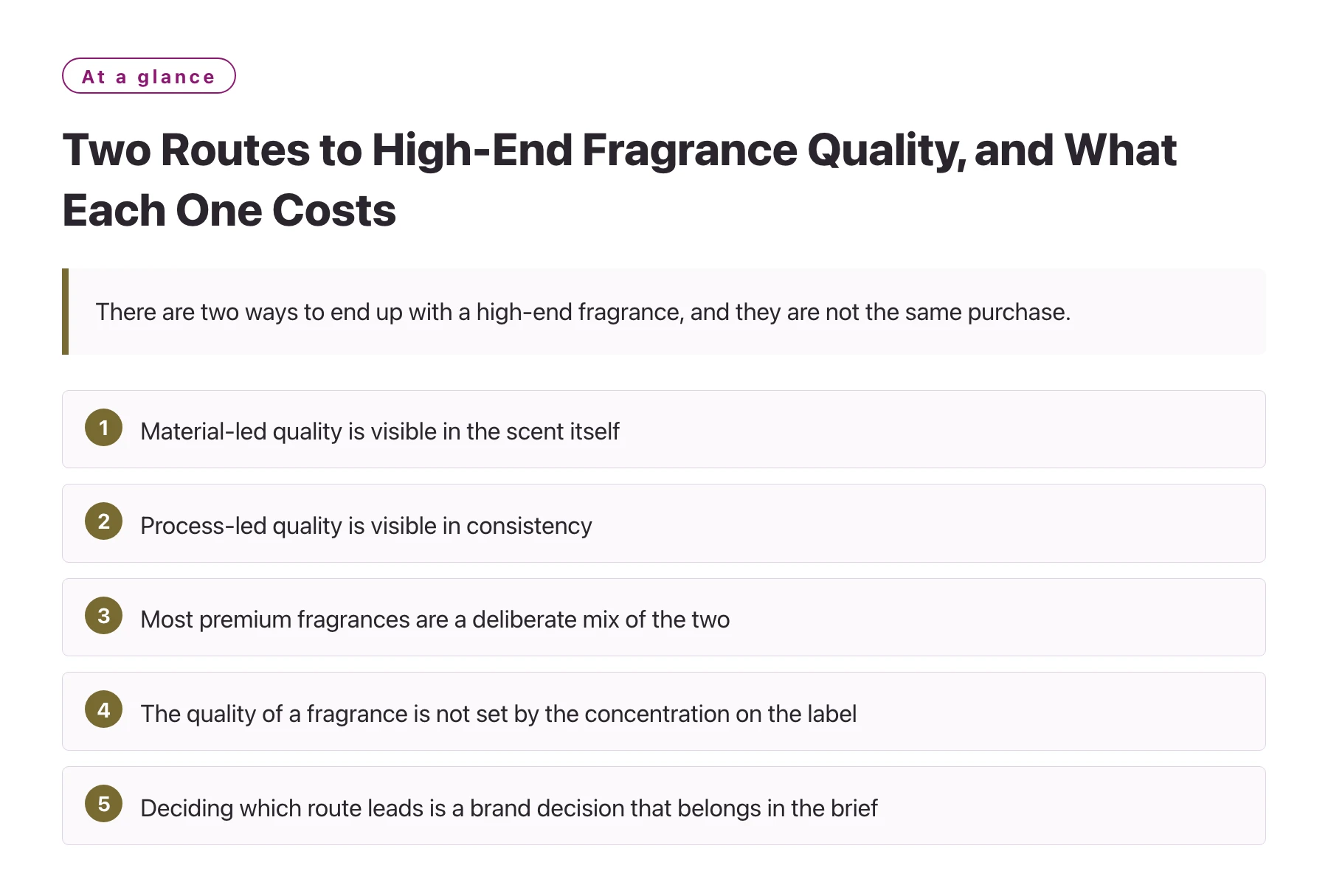
- Material-led quality is visible in the scent itself, but it raises unit cost in a way that volume does not reduce very much.
- Process-led quality is visible in consistency, in the bottle and in the paperwork, and its cost is largely fixed rather than per-unit.
- Most premium fragrances are a deliberate mix of the two, with one route clearly leading and the other treated as a supporting standard.
- The quality of a fragrance is not set by the concentration on the label; it is set by which materials are in the compound and how consistently the batch is made.
- Deciding which route leads is a brand decision that belongs in the brief, because a supplier cannot optimise for both without being told which one wins.
Ask five people what makes a fragrance premium and you will get five answers: the oil percentage, the bottle weight, the perfumer's name, the country of manufacture, the price. Each answer describes one of the two routes, and each is a partial view.
The distinction is commercially useful because the routes trade off against each other. Money spent on a higher dose of an expensive material is money not spent on heavier glass or tighter filling tolerances. A brand that never chooses tends to receive an average of everything, which is exactly how a product ends up priced like a luxury item and read as a mid-market one.
Route A: quality carried by the materials
In this route the differentiation is inside the liquid. A higher proportion of a costly natural, a signature captured at high dosage, a longer resting period before filling, and a base built to hold the top notes rather than let them collapse in the first hour. None of this shows on the outside of the bottle, and all of it is detectable by anyone who wears the product for a day.
The cost structure is unforgiving. Material-led quality is largely variable cost, so it does not disappear at volume; a compound that costs more per kilogram costs more per bottle whether you make one thousand or one hundred thousand. The compensating advantage is that it is hard to copy quickly, because a competitor matching the scent has to match the spend.
What it requires from the brief
Route A needs a brief that names the materials or the materials class, and a budget that survives the first quote. It also needs a brand that is willing to accept a lighter initial projecting scent, since heavier bases and higher natural content often read as quieter on the opening than a bright synthetic blend of the same strength.
It benefits from an early decision about resting time, because maceration adds calendar days that a launch plan has to absorb rather than discover [1]. Compliance limits also shape what is achievable, since some materials have use restrictions that cap how far a designer can push a favourite accord.
Route B: quality carried by the process
In this route the differentiation is in how reliably the product is produced. Weighing accuracy, compounding order, filtration, bottle cleaning, crimp height, leak testing, batch retention and the paperwork that ties a delivered unit back to a record. The scent may be good rather than remarkable, but bottle ten thousand smells and sprays the way bottle one did.
Process-led quality is mostly fixed cost. Equipment, calibration, trained operators, quality staffing and documentation are paid for whether the line runs at full capacity or not, which means the per-unit surcharge falls as volume rises. That makes it the more attractive route for a brand planning to scale, and the less attractive one for a small first run.
It is also the route that a buyer can verify without wearing the product. Sampling from a batch, checking a fill weight, examining a crimp and asking to see a retention record are all tests that can be run on site, which is why process-led claims are easier to audit than material-led ones.
Signals that tell you which route a supplier really leads with
| Signal | Points to material-led | Points to process-led | Why it reads that way |
|---|---|---|---|
| The first question asked of you | What should the scent say, and for whom | What volumes, which markets, which bottle | One route plans from the perfume outwards, the other from the line inwards |
| How material choices are discussed | Named materials, grades and origins | Material cost bands and availability windows | Both matter, but the vocabulary reveals the working habit |
| What the sample record contains | Modification notes and sensory description | Batch code, fill weight and test results | The record shows what the supplier thinks the customer will check |
| Where the premium charge sits | Higher compound cost per kilogram | Higher tooling, testing and finishing cost | The same label covers two different economics |
| Quality failures you would expect | Scent drifts toward the middle as a material is substituted | Cosmetic defects, leaks and inconsistent spray | Each route has its own characteristic failure |
| How copyable the product is | Hard to copy without matching the spend | Easier to copy, because the difference is invisible | Process quality protects the brand experience, material quality protects the scent |
Most suppliers can do both to some degree. The table is for finding out which one they lead with, because that is the one they will protect when a project gets difficult.
Why the two routes cost differently at scale
A brand that chooses materials pays for them on every unit. A brand that chooses process pays for the capability once and then enjoys it on every unit. This is the reason premium ranges in large distribution tend to be process-led, while small houses building a signature tend to be material-led. It is not a taste difference; it is an economics difference.
The material side also carries a supply risk that the process side does not. Natural materials vary by harvest, and a compound that depends on a specific grade has to be re-approved when the supply changes. Most of what a modern fine fragrance contains is defined aroma chemicals rather than natural extracts, and their purity and grade can shift a blend's character even when the formula is unchanged [2]. A supplier that flags this at the brief stage is saving the brand a future reformulation.
Safety assessment sits across both routes. Fragrance materials are evaluated for skin exposure and some are restricted by use, so a higher dose is not automatically available even when the budget is [3]. Route A therefore has a ceiling that is set by regulation rather than by money, and discovering that ceiling during the first trial is normal.
What a high-end claim should be able to prove
A brand positioning above the mid-market should be able to point to something specific. For a luxury fragrance manufacturer the honest proof is usually a combination that spans both routes: the material specification of the compound, the filling and finishing tolerances, the batch retention system and the market documentation that travels with the goods luxury fragrance manufacturer. Each of those can be described in a sentence and checked in a document.
What should not be accepted as proof is a claim about the concentration on the label alone. The percentage describes how much compound is in the formula, not what the compound is made of, and two products at the same percentage can sit at opposite ends of the market dilution levels in fine fragrance. Premium positioning that rests only on that number is a positioning that any competitor can match with a printer and a new carton.
The practical test for a brand is to ask, on a video call or during a visit, to see the records behind one recent batch and to hear how a deviation would have been caught quality control in luxury fragrance production. Suppliers who lead with process answer this easily and specifically. Suppliers who lead with materials answer it by talking about the scent, which is a reasonable answer, but not to the question that was asked.
Pick the leading route before the quote, not after. A brief that says quality matters is unactionable; a brief that says the scent must justify the price and the batch must be repeatable, with the scent as the priority, is something a supplier can actually plan for.
Sources
- IFRA Standards Library (International Fragrance Association) —— The IFRA Standards Library lists the restrictions the fragrance industry applies to individual fragrance ingredients, based on safety assessments; it is the reference point for compliant fragrance formulation.
- Chemistry World (Royal Society of Chemistry) —— The Royal Society of Chemistry's magazine, covering chemistry research and explanations of everyday materials including aroma compounds.
- EU Scientific Committee on Consumer Safety (SCCS) —— The EU scientific committee that issues opinions on the safety of cosmetic ingredients, including fragrance allergens and their labelling thresholds.
Frequently asked questions
Is a higher fragrance concentration the same as higher quality?
No. Concentration describes how much compound is in the formula. Quality is decided by which materials make up that compound, how it was built and how consistently it is produced.
Can a brand pay for both material-led and process-led quality?
It can, and some do, but the cost stacks. On a first run the money is usually better spent on the route that supports the brand's actual selling point, with a defined minimum standard for the other.
Which route suits a small first order?
Material-led quality can be delivered at almost any volume because it is variable cost. Process-led quality has fixed costs that are hard to absorb in a small run, so a small order usually buys the materials and accepts standard finishing.
How can a buyer verify a premium claim without technical staff?
Ask for the compound specification, one recent batch record, the fill and finishing tolerances, and the market documentation pack. Anything that cannot be produced as a document is a claim rather than a control.
Does premium manufacturing require a different factory from mid-market production?
Not necessarily. Many facilities run both, with different equipment settings, tighter inspection and different documentation for the premium line. What changes is the discipline applied to the same building.
Get the next Dispatch in your inbox.
Join 67,400 readers. Free, weekly, no sponsored placements.