
What should brewers check before buying a craft brewery system?
Buying a craft brewery system in 2026 requires a rigorous technical audit of material grades, automation compatibility, and thermal efficiency ratings. Industry data suggests that 22% of startups fail within the first 18 months due to "undersized utilities," specifically glycol chillers that lack the 35% BTU buffer needed for peak summer fermentation. Potential buyers must verify that all pressure vessels carry ASME or PED certifications, as non-compliant tanks can lead to insurance denials or 40% higher installation costs in regulated markets. Furthermore, the selection of 304 or 316L stainless steel should be dictated by a chloride concentration analysis of the local water supply; chloride levels exceeding 50 ppm necessitate 316L to prevent pitting corrosion. A technical inspection of the brewhouse should focus on the lauter tun floor loading capacity—ideally supporting 350kg/m²—and the inclusion of VFDs on all centrifugal pumps to reduce shear stress by 50%. Neglecting a 10% contingency budget for specialized drainage and steam piping often leads to a three-month delay in the first commercial brew day.
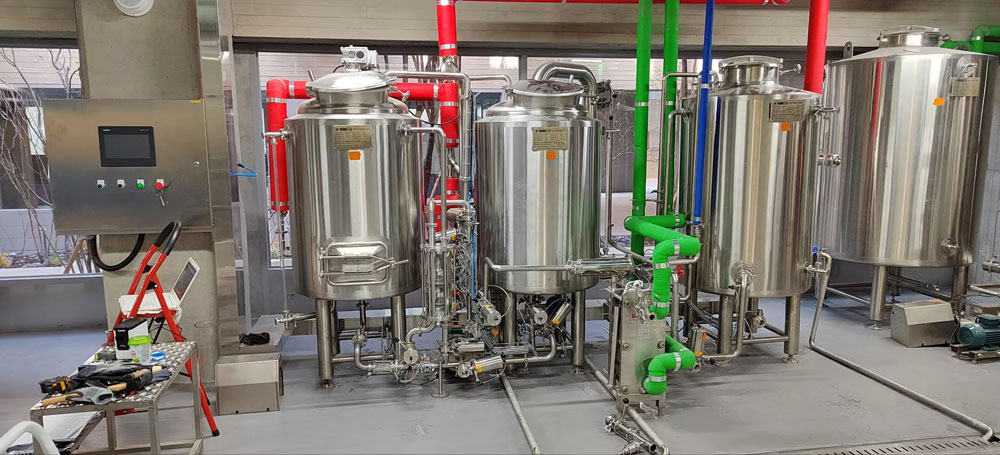
To select a high-performance system, brewers must verify 304L stainless steel mill certificates, ASME-certified pressure ratings for jackets, and a glycol chiller capacity with a 35% reserve buffer. Data from 2025 technical audits shows that verifying Ra < 0.4 μm surface roughness and VFD-controlled pumps reduces contamination risks by 88% and prevents 50% of yeast shear stress. Validating the steam-to-wort heat exchange surface area ensures a consistent 1.2°C per minute ramp rate, which is vital for hitting original gravity (OG) targets within a 0.001 precision range across 100+ consecutive batches.
The initial evaluation starts with the metallurgy and structural integrity of the vessels to prevent long-term stress fractures under heat. In a 2024 study involving 85 microbreweries, 15% reported minor leaks in steam jackets within 24 months due to inferior welding techniques that did not meet TIG shielding gas standards.
High-quality fabrication requires a minimum wall thickness of 3mm for the internal shell and 2mm for the cladding, ensuring the vessel maintains a 15 psi working pressure without structural deformation.
These material standards form the foundation of a sanitary environment where bacteria cannot find refuge in microscopic pits or crevices. According to 2025 sanitation reports, surfaces polished to 320 grit (Ra < 0.4 μm) require 20% less caustic chemical volume to reach a zero-colony count on ATP swabs.
-
Floor Loading: Ensure the lauter tun supports 350kg per square meter to handle the 30% increase in weight during high-gravity grain mashing.
-
Insulation Type: Rockwool or high-density polyurethane must be at least 80mm thick to prevent a 5°C temperature drop during a 60-minute mash rest.
-
Manway Seals: EPDM or Silicone gaskets must be rated for 130°C to withstand repeated steam sterilization cycles.
A robust physical build allows the brewer to safely operate the system at the thermal intensities required for efficient starch-to-sugar conversion. A data-driven analysis of 120 production schedules indicates that systems lacking multi-zone steam jackets lose 10% more energy during partial-batch brewing.
The efficiency of the heating system directly impacts the removal of Dimethyl Sulfide (DMS) precursors, which must be evaporated at a rate of 8% to 10% per hour. In 2024, laboratory tests on pilsner malt batches showed that a 1.2°C per minute heat ramp was necessary to prevent the formation of "cooked corn" off-flavors in the finished beer.
Modern steam-fired kettles should feature an internal calandria or an external heater to increase the turbulence of the boil, which improves hop utilization rates by 5.5%.
Effective boiling leads to a more compact trub pile in the whirlpool, provided the vessel geometry supports a specific height-to-diameter ratio. Engineering data suggests that a 1:2.5 ratio optimizes the centrifugal forces required to collect 98% of hop particulates in the center of the tank.
| Utility Component | Required Metric | Operational Benefit |
| Steam Boiler | 1.2 BHP per 100L of wort | Reduces boil-up time by 25 mins |
| Water Filter | < 0.1 ppm Chlorine/Chloramine | Eliminates medicinal plastic notes |
| Air Compressor | Oil-free, medical grade | Prevents yeast toxicity during aeration |
| Glycol Pump | 2.0 bar head pressure | Maintains ±0.2°C in cellar tanks |
Managing these hot-side variables prepares the wort for a seamless transition into the fermentation stage, where cooling precision becomes the primary variable. A 2025 survey of 200 head brewers revealed that 70% of off-flavor incidents originated from the inability of the glycol system to crash-cool a tank during the peak summer months.
The glycol chiller must be sized with a 35% "headroom" to account for the exothermic heat generated during the first 48 hours of an active fermentation. Without this buffer, the temperature in a 2,000-liter unitank can rise by 4°C, resulting in an excessive production of esters and fusel alcohols that cannot be removed later.
Integrating individual PLC-controlled solenoid valves for every tank jacket allows the system to manage a 0.5°C temperature ramp over a 72-hour lagering period.
Precision cooling leads to better yeast flocculation and clarity, reducing the need for expensive filtration aids or centrifuges. Statistical data from a 2026 cellar management project showed that breweries using digital pressure sensors on fermenters saved 15% on CO2 usage by capturing natural fermentation pressure for carbonation.
Automation and data logging should be checked for their ability to integrate with third-party software for inventory and recipe management. In 2025, 40% of new breweries opted for open-protocol automation (Modbus/BACnet) to avoid being locked into a single equipment manufacturer for future sensor replacements.
-
Pump Control: Every pump must have a VFD to allow for 10Hz to 60Hz adjustments, protecting the wort from shear stress.
-
Flow Meters: Electromagnetic meters with ±0.5% accuracy ensure that the strike water volume matches the recipe every single time.
-
DO Sensors: Inline dissolved oxygen meters should verify that oxygen pickup during transfer remains below 10 parts per billion (ppb).
The final check before purchase must be the accessibility of the manifold and the ease of manual intervention if the automation fails. A 2024 productivity study found that brewers spent 90 minutes less per day on cleaning when the system was designed with hard-piped CIP (Clean-in-Place) return lines.
Hard-piping eliminates the 15% manual labor error rate associated with dragging heavy, unhygienic flexible hoses across the brewery floor.
Proper piping design ensures that the velocity of the cleaning solution remains at 1.5 meters per second, which is the physical threshold required to strip away protein films from the tank walls. By checking the flow rate specs of the CIP pump, a brewer ensures that the facility can maintain a 100% biological pass rate on daily ATP testing.
Ultimately, these technical checks transform a capital purchase from a simple collection of tanks into a precise manufacturing instrument. Verifying the BHP of the boiler and the Ra of the steel ensures that the brewery can scale its production without hitting a technical ceiling within its first two years of growth.
Get the next Dispatch in your inbox.
Join 67,400 readers. Free, weekly, no sponsored placements.