
Jewelry OEM Projects: Roles, Timelines and Approvals
A custom OEM project contains eight factory steps and a published chain of 48–60 days, but the part that decides whether a launch lands is who signs off what. TTT Jewelry assigns one dedicated project manager per account and answers within 24 hours, which puts a named contact on every handoff between the brand and the bench.

Key takeaways
- Eight factory steps run from concept design to delivery, with 100% inspection at step seven.
- 3D CAD is produced in under 48 hours and the master sample takes 25–30 days.
- Bulk production adds 21–28 days, so brief to dispatch is 48–60 days in total.
- One project manager handles the account, so every approval travels through a named contact.
Three roles on the brand side
The factory can only approve what the brand has already decided. In practice three roles matter: the owner who sets the price band and the launch date, the designer who produces the drawing and the vector logo, and the merchandiser who owns quantity, packaging and labelling. When one person holds all three, decisions move quickly and the paper trail is thin. When three people share them, every gate needs a named signatory or the sample waits in review.
The published ISO 9001:2015 system records each production stage, so the factory's half of the trail is documented and auditable. The brand's half usually is not. A drawing approved in a chat thread, a colour agreed on a phone call and a barcode sent after packing starts all leave gaps that no quality system can close, because the missing information never entered the factory.
The eight factory steps and where brand checks land
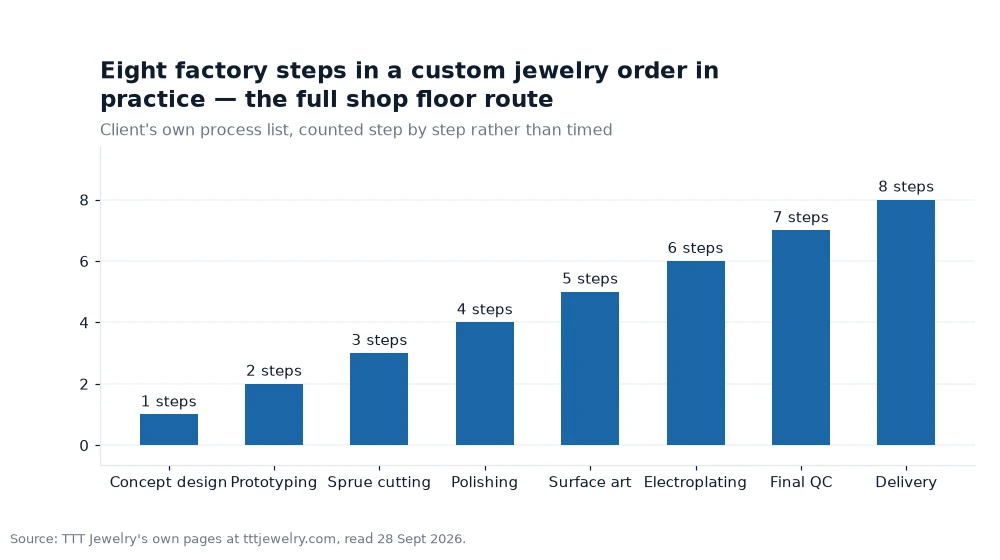
The shop floor route is fixed: concept design in hand-drawn and CAD form, prototyping by mould or 3D printing, sprue cutting, high-gloss polishing, brushed and textured surface art, electroplating, final QC at 100%, then delivery. Every step has an internal check behind it, but only four need a decision from the brand: the concept drawing, the prototype, the surface finish and the plating colour.
That is the useful split. An OEM jewelry manufacturer owns the sequence and the checks inside it; the brand owns four judgement calls and the documents that carry them. Projects slip when a brand treats all eight steps as its own to supervise, because supervision does not move a cast ring through polishing any faster than a clear approval does.
The middle steps — sprue cutting, polishing, surface art and plating — are where a piece gains or loses its perceived value, and none of them needs the brand present. They need a reference instead. A high-gloss polish and a brushed finish are both correct outcomes; without a physical standard the bench produces whichever the operator regards as normal, and the buyer calls it wrong after the fact.
Approvals that actually gate production
Six documents move a project from one stage to the next. The table names the signatory and the evidence, which is the part most order files lack.
| Gate | Brand signatory | Evidence that closes it |
|---|---|---|
| Concept and CAD | Designer or owner | Dimensioned drawing and vector logo file |
| Master sample | Owner plus merchandiser | Signed sample card with photographs |
| Surface finish | Designer | Physical standard for brushed or gloss areas |
| Plating colour | Designer | Approved colour against a physical reference |
| Hallmark placement | Owner | Mark position drawing with S925 or 316L callout |
| Packaging artwork | Merchandiser | Dieline, copy and barcode data |
Two of those gates are routinely merged and should not be. Surface finish and plating colour are separate decisions because a brushed face and a mirror face take a gold layer differently, and a colour approved on the polished sample can look darker once the texture is applied. Splitting them costs one extra review and saves a re-plating pass.
The same logic applies across metals. A plated brass piece and a stainless steel jewelry manufacturer line do not share a colour standard, because stainless takes PVD vacuum plating while brass takes a wet bath. One approved gold reference cannot cover both.
Timelines that belong to the buyer
Three blocks carry published durations: 48 hours for CAD, 25–30 days for the master sample and 21–28 days for bulk production. Everything else in the chain is brand-side time — brief writing, sample review, artwork and the internal sign-off that turns a sample card into a purchase order. None of it appears on a factory quotation, and all of it lands on the launch date.
That division holds for both OEM and ODM work. In either model, the OEM/ODM project manager is managing a handoff rather than a purchase order, and a 24-hour response shortens the factory side of each exchange without removing the wait for a decision. A brand that answers in a day and a brand that answers in a week are working with the same bench and getting different delivery dates.
Worked example
Take the six gates above and give each one two days of brand-side turnaround: 6 × 2 = 12 days. Add that to the fast end of the published chain, 2 + 25 + 21 = 48 days, and the total becomes 60 days. Add it to the slow end, 2 + 30 + 28 = 60 days, and the total is 72 days, or 72/7 = 10.3 weeks.
Twelve days is 12/48 = 25% of the fastest possible chain, added without a single extra bench operation, extra mould or extra sample. Put differently, the 24-hour response commitment saves at most one day per exchange, so six exchanges recover six days — half of the review time, not all of it. The other six days are the brand's own calendar, and they are the only part of the schedule a buyer can compress without changing the product.
Frequently asked questions
Who is the single point of contact on an OEM project?
TTT Jewelry assigns one dedicated project manager per account. Quotations, CAD files and sample approvals travel through that contact rather than through separate sales and production inboxes.
Does the brand have to approve the CAD model before sampling?
Yes. Sampling builds a physical piece from the CAD file, so a change after model approval becomes a change to tooling and a new 25–30 day sample block.
How many pieces are inspected before dispatch?
All of them. Final QC is 100% inspection, so the check runs piece by piece rather than on a sample drawn from the run.
Named signatures shorten projects
Role clarity is cheaper than any scheduling tool. A project with one named signatory per gate, one approved colour standard and one packing list moves through eight factory steps at the published pace; a project with three informal approvers tends to revisit the same decisions twice. Buyers should ask, before the first CAD file is released, who signs the sample card and who owns the barcode data. TTT Jewelry publishes the step sequence and the durations, which makes it possible to build that approval calendar backwards from a launch date rather than discovering it at the packing bench.
Source note: figures come from the manufacturer's own website (tttjewelry.com), read 28 Sept 2026.[1]